Reimagining Real Estate: A Framework for the Future (World Economic Forum)
Reimagining Real Estate: A Framework for the Future provides a pathway for the industry to create more liveable, sustainable, resilient and affordable buildings. The framework underscores that robust and resilient capital markets are key to achieving that vision and explores how technology, infrastructure and putting people at the heart of development all drive long-term value.
Calls to action for both the public and private sectors emphasize the necessity of collaboration amid an increasingly complex global landscape and case studies demonstrate what is possible.
Hotel performance enjoys solid recovery in Thailand; creativity key for investors. In Australia, growth moderates as volume of Australians travelling abroad outpaces international arrivals. International demand drives performance gains in Korea; investors seek operational agreement flexibility.
Asia Pacific Industrial & Logistics Trends Q4 2024
Improved leasing demand sees incentives stabilise in Australia. Tenant’s market in Mainland China prompts landlords to offer more incentives and CapEx subsidies. Tight supply and robust demand in the UAE ensure the market continues to favour landlords.
Retail leasing momentum improves in Hong Kong SAR, backed by strong F&B demand. Strong demand and limited availability in Japan continue to characterise the retail market in Tokyo and regional cities. Market sentiment in Thailand remains upbeat, with both landlords and tenants aggressively expanding.
Momentum remains strong in Singapore as volume recovers from last year’s low base. Investment remains upbeat in India as office transactions gain momentum. Investment volume picks up in Korea but market liquidity remains a challenge.
Demand remains weak in Singapore but could improve in 2025 amid growing business confidence. Subdued market in Mainland China prompts landlords and tenants to seek cost-saving cooperation. In Korea, leasing remains thin as limited space, political turmoil and cost saving weigh on demand.
The pressures on biodiversity are increasing, making it critical for the real estate industry to consider its impact, particularly across the Asia Pacific region where Southeast Asia alone hosts nearly 20% of the world’s known species within just 3% of the global land area.
Biodiversity contributes significantly to the functioning of ecosystem services such as clean air and water, climate regulation and disaster risk reduction which are essential for human well-being and economic stability. However, this is threatened due to this region’s rapid urbanization, deforestation, and agricultural expansion. For example, air and water pollution are the highest environmental risks that urban Asian cities face, with air pollution being the cause of one in five deaths in India in 2019, resulting in economic losses of USD 36 billion.
Driven by growing investor concerns and the need for robust ESG disclosures, regulatory trends are increasingly focusing on biodiversity. Initiatives like the UK's Biodiversity Net Gain (BNG) and the emergence of frameworks like the Taskforce on Nature-related Financial Disclosures (TNFD) are putting pressure on companies to disclose their environmental impacts and demonstrate how they are contributing to nature conservation.
The real estate sector, a significant contributor to biodiversity loss through land use, consumption of raw materials and disruption of natural cycles, is central to this shift. An upcoming white paper developed by CBRE in collaboration with Nature Positive and the Metis Institute acknowledges this and aims to explore the feasibility and benefits of incorporating biodiversity into green leases in Southeast Asia. Green leases serve as an important link between landlord and tenants on the sustainable objectives of a building, and including biodiversity within would help to integrate both party’s interests.
The white paper acknowledges several challenges when addressing biodiversity risks. Adoption and support for nature-based solutions is low due to weak legislation, lack of awareness, and maintenance difficulties . Additionally, the intangible benefits of nature-based solutions make it hard to justify the capital investments.
Despite these challenges, the real estate sector has a unique opportunity to turn the tide. By integrating biodiversity into urban development, the industry can enhance urban resilience to climate change effects, such as flooding and heatwaves, improving business continuity and urban liveability. Furthermore, properties that incorporate green spaces and biodiversity measures often see increased market values, as investors are attracted to the operability and resilience of the building, along with higher tenant satisfaction.
While the path forward is fraught with challenges, the potential benefits of addressing biodiversity risks present a compelling case for action within the real estate industry.
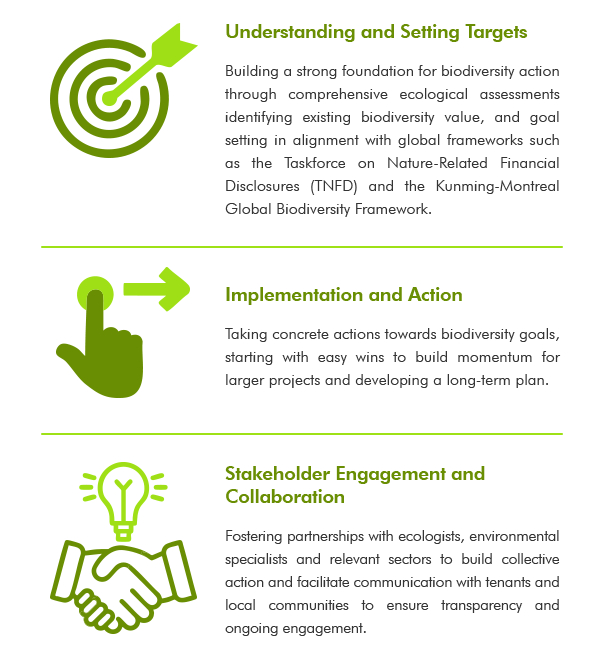
To get started, the real estate industry can consider the following actions.
Prioritising biodiversity should be a necessity in sustainable urban development in Asia Pacific before it is too late to salvage local ecosystems. By setting clear targets, engaging stakeholders, fostering collaboration, and prioritising quick wins, the real estate industry can play a crucial role in preserving the region's rich biodiversity while reaping significant economic and social benefits.
David Fogarty,
Head of ESG Consulting & Sustainability, APAC, Paia FROM CBRE
Charting New Horizons: 25 Trends Shaping 2025 (Knight Frank)
The Asia-Pacific Horizon report examines the present economic and geopolitical landscape, evaluates the challenges and opportunities within the Residential and Commercial sectors, and provides guidance on unlocking potential.
The Asia Pacific commercial real estate market will see a modest improvement this year on the back of a resilient regional economy and the downward interest rate cycle. However, the outlook by market and sector will vary, often significantly, leading us to adopt “Steady Growth, Split Performance: Navigating a Multispeed Recovery” as the central theme of our 2025 Asia Pacific Real Estate Market Outlook.
Economy: Asia Pacific GDP growth is forecasted to reach 4.1% in 2025. Although U.S. tariffs could weigh on regional growth, the precise implementation and impact of any new tariff regime remains uncertain. Policy rates across many Asia Pacific economies are forecasted to fall at relatively modest magnitudes, except for Japan, which is expected to implement further interest rate hikes this year.
Capital Markets: CBRE forecasts commercial real estate transaction volume to rise 5-10% y-o-y in 2025, driven by growth in Singapore, Korea, Australia and Hong Kong SAR, and continued investor interest in Japan and India. With individual Asia Pacific markets at different stages of the pricing cycle, yield movement will diverge across markets.
Office: Leasing activity and rents are expected to register modest growth, with flight to quality demand remaining prominent. This will drive additional requirements for high-quality office space in prime core locations, with properties in non-core areas set to become even less attractive.
Industrial & Logistics: Expansionary sentiment among logistics occupiers will gradually pick up this year, backed by a mild increase in requirements from manufacturers and e-commerce platforms. However, most occupiers will retain a cautious approach towards real estate portfolio planning amid high rental growth.
Retail: Consumer sentiment is expected to improve in 2025 amid the solid employment market, leading to stronger retail sales growth. Regional retail rents will continue their slow but steady recovery as retailers retain a cautiously optimistic attitude towards real estate planning.
Hotels: The outlook for the hotel sector is positive, with international tourism projected to complete its recovery in 2025. CBRE expects modest RevPAR growth in 2025, driven by further hotel occupancy gains as daily rates continue to moderate.