Market Outlook

The Asia Pacific office demand declined from 103 million sf in 2019 to 53 million sf in 2020 as occupiers sought to limit cost exposures during the COVID-19 pandemic.
In line with this decline in demand, vacancy has increased, and rents have softened across most markets, pushing them towards greater tenant-friendly status and providing occupiers with a window of opportunity in negotiating any forthcoming lease commitments.

However, corporate occupiers need to be aware that these changes may not bring the cost savings that they might expect – some markets may see tenants having to pay more on a new lease than they were paying on the last year of an expiring lease.

In our Asia Pacific Office Rental Variability Index we take a closer look at:

  • The current state of play in 36 key office cities across Asia Pacific
  • The extent of, and variability in, rental change over the duration of average lease terms at the city level
  • Strategies that occupiers might wish to explore to help navigate the impacts of this rent variability
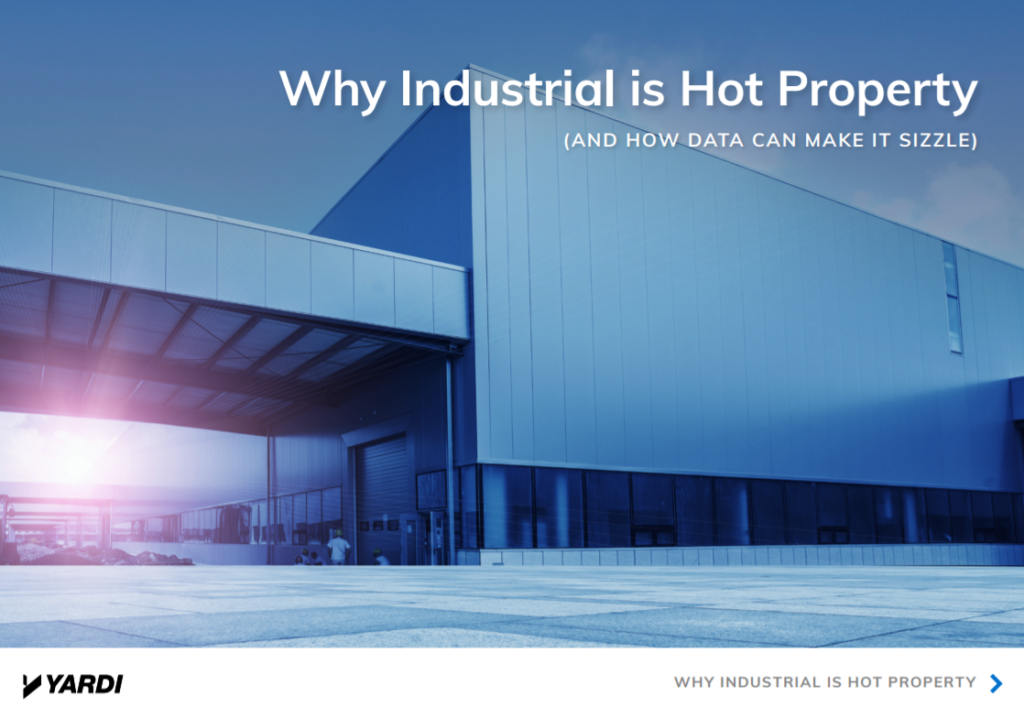
The COVID-19 pandemic caused a high degree of uncertainty across the Queensland economy and the commercial property market. However, the Industrial and Logistics sector (I&L) has been the clear winner particularly as e-commerce penetration accelerated over the past 18 months and is one of the key drivers of demand for floorspace. Investors have responded by seeking to increase their exposure to the sector, and now investment sale volumes in Queensland was the highest on record in 2020.

This report will detail some the key trends driving the Brisbane industrial and logistics market, and provides greater insights on the supply and take-up of industrial land.

  • Commercial real estate investment momentum accelerated in Q2 2021 as the economy continued to pick up along with the commencement of the city’s vaccination programme.
  • Property funds collectively deployed HK$5.4 billion, 21% of the quarter’s total, with all acquisitions involving industrial assets.
  • Hong Kong’s economic recovery, improved prospects of a border reopening with mainland China, and low financing costs will ensure the investment market remains upbeat in H2 2021.

Most efforts to manage climate and ESG portfolio risks have involved reducing holdings of stocks negatively exposed to these risks, and increasing those that are positively exposed. Professionally managed ETFs and mutual funds have been a natural starting point for investors to align exposures with their objectives, but index derivatives could have a critical part to play, being one of the largest global markets with a substantial role in the financial system and the management and transfer of risk. We investigate the potential for derivatives to help market participants seek to efficiently align exposures with their objectives, while facilitating transparency, price discovery and market efficiency.

• The investment sales volume rose for a fi fth consecutive quarter, up by 62.0% quarter-on-quarter (QoQ) to S$6.18 billion in the second quarter of the year. Compared with the same period last year, investment sales nearly tripled from the low base established when Singapore was under the Circuit Breaker period.

• Residential investment sales constituted the largest proportion of total investment sales of 48.6% in the quarter, increasing by 60.0% to S$3.0 billion.

• Investment sales in the commercial segment continued to grow by 57.5% to S$2.24 billion, with the increment largely attributed to the 75.7% expansion in offi ce investment sales due to more block transactions.

• With stronger performance of the manufacturing sector and growth in the e-commerce and logistics sectors, the industrial segment registered close to S$924.0 million in Q2/2021, up 88.2% from the previous quarter.

• As the vaccination program progresses and with Covid-19 infections in Singapore under control, investor sentiment is expected to remain strong, and this may lead investment sales to return to pre Covid-19 levels in the near future. Yields will compress further as capital piles into the limited stock of investable assets.

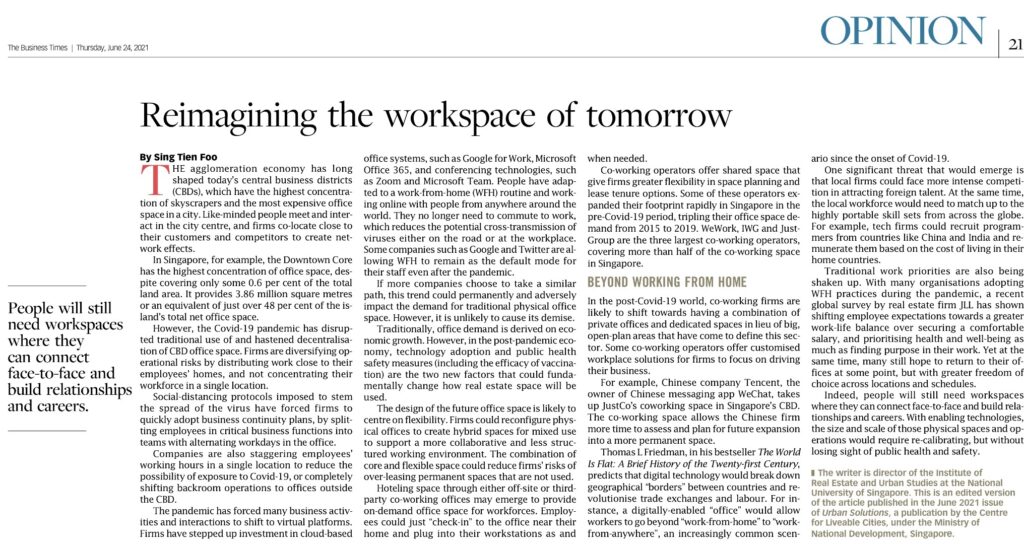
The COVID-19 pandemic has changed the way we live and work. Long-running conversations surrounding the traditional office model have only proliferated in recent times. In response, we are now seeing new trends in strategies for corporate real estate arise from businesses around the world. When asked about expectations of change in their total amount of space in global portfolios, APAC respondents from the (Y)OUR SPACE 2021 global survey* have been more bullish than their global counterparts. 30% more APAC respondents said that they are likely to increase rather than decrease space. Comparatively, there are 5% more global respondents who are likely to decrease their portfolios than increase.

The Asia Pacific (APAC) region is experiencing a boom in infrastructure investing. The Infrastructure sector in countries that include India, Indonesia, China, Australia, Philippines, Myanmar, Vietnam, Thailand and Singapore is expected to grow 7% to 8% per year over the next decade.

For more information visit: 

https://www.ssctech.com/resources-insights/brochures/view/apac-infrastructure-boom-drives-demand-for-technology-enabled-service-providers

Market adjustment slows

Although the market continues to correct, we note signs that the rate of adjustment is slowing.

• For the central fi ve wards (C5W), COVID-19 is still taking a toll on the market and casting a shadow over the market’s future, although the impact appears to be showing signs of alleviation. • Average Grade A offi ce market rents in the C5W fell 1.9% quarter-on-quarter (QoQ) and 5.3% year-on-year (YoY), and now stand at JPY35,762 per tsubo1 per month.

• The average Grade A offi ce vacancy rate in the C5W increased slightly by 0.2 percentage points (ppts) QoQ to 1.2% in Q1/2021.

• Average large-scale Grade B offi ce rents declined to JPY27,275 per tsubo per month – a contraction of 2.1% QoQ and 4.5% YoY.

• The average vacancy rate in the Grade B market lies at 2.2% following a loosening of 0.6ppts QoQ and 2.0ppts YoY.

• With limited supply expected this year and the next, the market should have time to adjust and recover, although secondary vacancy derived from the large supply in 2020 is a concern.

• While prime real estate is expected to hold steady, rents in poorly located and older offi ces are likely to fall, resulting in an overall market deterioration.