Asia Pacific Leasing Market Sentiment Index (CBRE)
While tenant enquiries and site visits remain frequent, momentum cooled from the previous survey. Although enquiries and inspections in mainland China were active, occupiers’ cautious stance resulted in a limited number of actual transactions.
Expansionary demand grew across the office and retail sectors but fell for industrial. Australia and Japan registered a rise in requirements for more space, while India continued to see robust new set up and expansion demand.
Two-thirds of respondents expect rents and incentives to stay flat. The view in mainland China is slightly negative, with rents forecasted to decline.
Despite falling slightly from the previous quarter, leasing sentiment in most markets stayed in positive territory. Sentiment in mainland China remains negative and will take more time to recover.
Why Asia Pacific offices are different and now is the time to invest (CBRE)
Despite a challenging global economic environment and recent muted investment sentiment, the Asia Pacific commercial real estate market has remained largely resilient. In particular, the office sector remains an important asset class in the region, and one that investors should consider.
This report explores the opportunities presented by investing in the office sector in Asia Pacific, the supporting data and factors that differentiate this asset class from others, as well as the implications and potential strategies for investors.
Key highlights include:
Deal flow in Asia Pacific remains resilient despite weaker investment sentiment
The outlook for longer-term office demand is positive
Asia Pacific is leading office attendance globally
Price and rental correction has created a window of opportunity
A Tale of Two Cities: Hong Kong SAR vs Singapore (CBRE)
Hong Kong SAR and Singapore are both firmly established as popular locations for multinational corporates to locate their Asia Pacific headquarters.
While the two cities have always enjoyed a competitive rivalry, recent sociopolitical developments and the enactment of anti-pandemic measures, although now abated, have prompted some companies to think about their operational and physical footprint in the region.
This report compares the two markets across seven key factors:
Influence in Asia Pacific
Scale of financial industry
Scale of technology industry
ESG and green building initiatives
Talent availability and attraction
Office rents/price
Office availability
The report also discusses topical issues such as:
How the two cities are set up to develop and grow in the post-covid world
The competitive advantages of the two cities across industries
Whether real estate pricing and rental gaps are narrowing, and by how much
How the two cities will evolve over the next decade with reference to government master plans
Colliers’ latest Impact Report provides an overview of their progress towards their Environment, Social and Governance (ESG) goals and performance in 2022.
The report is structured according to the three pillars of their ESG strategy, Elevate the Built Environment: the environment, inclusiveness, and health and wellbeing, which represent the key areas where they can drive the most impact for our people, clients, and communities.
Their reporting is prepared with reference to the Global Reporting Initiative’s GRI Standards and frameworks set by the Sustainability Accounting Standards Board (SASB) and the Taskforce on Climate-Related Financial Disclosures (TCFD).
Setting the benchmark for sustainable data centers in China
GLP data centers are designed, built and operated in accordance with GLP’s ESG principles. In China, GLP is one of the largest independent data center operators with assets that will deliver over 1,400 MW of IT capacity. Our full-service data center platform is led by a best-in-class team of over 700 professionals with deep domain knowledge across IT, utilities and mobile communications companies. GLP has committed to ensuring that 100% of its new data center projects in China comply with GB-A/T3 1 standards and ODCC2 2 certification.
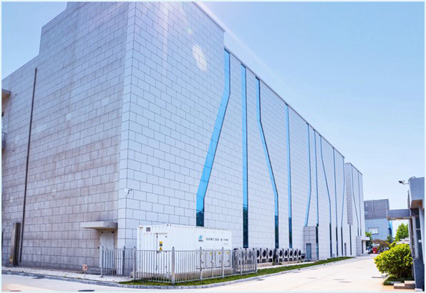
Case Study: GLP Beijing Yizhuang Data Center (“GLP Beijing Yizhuang DC”)
GLP Beijing Yizhuang DC is a tier 3 cloud data center with a total GFA of 18,230 sqm and 17.4 MW power capacity. It is located in greater Beijing which is one of the key data center hubs in China. Sustainability was factored in all stages of the asset lifecycle from design to operations and management.
GLP Beijing Yizhuang DC is designed with reflective roofs to reflect solar radiation, reducing the heat island effect and energy required to maintain overall building temperature. The data center is designed to utilize high voltage direct current (HVDC) power supply which is more energy efficient and cost effective than traditional alternating current (AC) power distribution. It also uses a chilled water cooling system which requires less energy than conventional air-cooled chillers.
All server rooms are installed with intelligent lighting systems which are configured to prevent energy wastage and the data center is equipped with sustainable lighting fixtures which are 100% mercury free. These initiatives earned GLP Beijing Yizhuang DC a 96 out of 100 score in its Energy Star evaluation by the U.S. Environmental Protection Agency (EPA). Water usage was reduced by approximately 27% through water-saving appliances and the upgrading of faucets and pipelines, and approximately 62% of the data center’s daily operation supplies are sustainably procured.
In addition to its advanced environmental design features, GLP also enhanced the sustainability of the data center’s day to day operations. GLP Beijing Yizhuang DC is equipped with GLP DC Base, a proprietary multi-data center smart operation and management system which utilizes centralized control model, digital twin, and artificial intelligence technologies to monitor and manage performance parameters such as temperature, humidity, water and air quality to optimize energy efficiency. Through these measures, GLP Beijing Yizhuang DC was able to save approximately 260 tonnes of carbon emissions in 2022.
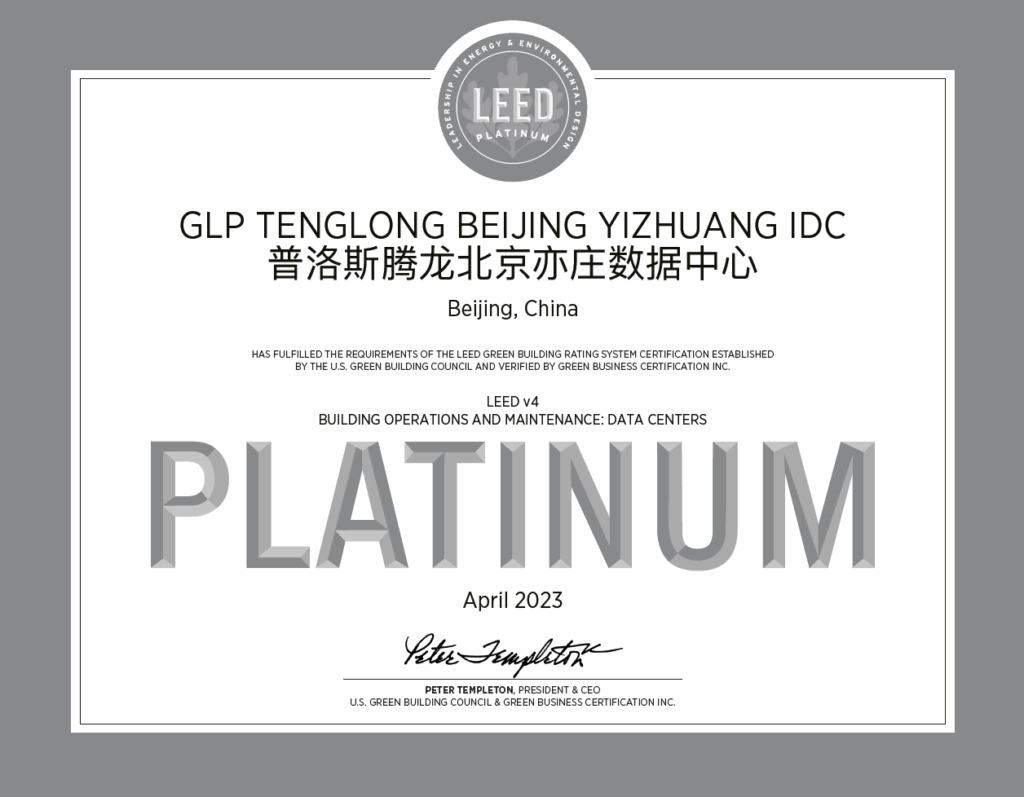
As recognition of its sustainable performance, GLP Beijing Yizhuang DC received Leadership in Energy and Environmental Design (LEED) v4 Platinum certification for building operations and maintenance. This is the highest level of certification by LEED, the most widely used green building rating system in the world, and GLP Beijing Yizhuang DC is one of the few data center infrastructure projects in China to achieve this level of certification.
1 GuoBiao (GB) standards are the highest classification of national standards with specifications issued by China for various products and services. A Tier 3 (T3) data center has multiple paths for power and cooling and systems in place to update and maintain it without taking it offline.
2 Open Data Center Committee (ODCC) is formed by key data center industry players with an aim to create an open data center platfor in China and promote the development, acceleration and standardization of the industry.
Real estate remains a key asset class within investors’ diversified strategies even as the turmoil in global financial markets and the instability across the capital spectrum continue to cause concerns.
That’s backed by some solid fundamentals, particularly in Asia Pacific. One, the region’s market resilience, versus its European and the US counterparts, put niche assets here on top of investors’ radar, and now, the reopening of China comes in as a shot in the arm. Two, the flight to quality – led by climate actions and return to office initiatives, has fuelled tight occupancy and rental growth across key Asia Pacific markets. Three, alternatives powered by the region’s living, logistics and life sciences sectors are luring investors with new opportunities and robust growth potential. There are several other reasons.
The moot point is the impact of rising interest rates on valuations and cap rates across key Asia Pacific markets appears mitigated, as rental growth remains powered by strong demand on the back of tight vacancy. However, it’s vital today for real estate investors to proactively map the next 12 months and ensure a winning action plan to make the most out emerging opportunities in the year ahead.
The State of Logistics Asia-Pacific Focus Report 2023 (Knight Frank)
The logistics sector in Asia-Pacific has seen increased interest from both investors and occupiers. This report highlights the prevailing trends including the diversification of demand, the continuing undersupply of logistics properties, and the implications for investors.
2022 Asia Pacific Real Estate Capital Flows (CBRE)
This report examines the investment capital flows to and from the Asia Pacific region in 2022, and highlights the key markets and sectors that saw notable inflows and outflows.
Key highlights include:
India was the only market in Asia Pacific to attract more international capital in 2022 compared to the previous year.
While Singapore remains the biggest source of capital in Asia Pacific, investment halved from 2021.
Western investment in mainland China fell to just US$500 million in 2022.
Interest and exchange rate volatility has eroded Asia Pacific investors’ appetite for U.S. real estate.
U.S. investment in Asia Pacific slowed significantly due to sharp interest rate hikes in H2 2022.