SS&C Intralinks’ new report, Gender Diversity and Dealmaking 2022, draws on data from more than 11,000 M&A deals announced between 2010 and 2021 and features commentary from senior dealmakers to understand this trend.
Download the new report to understand:
Why women CEOs outperformed men during the pandemic on post-deal share price, ROE, EBIT/sales and EBITDA/sales
How short-term investor reaction to deals announced by female leaders has slightly improved since our first report
Innovative female CEO M&A strategies and decision-making, such as managing risk by leveraging more advisors and structuring cash-only or all-stock deals
Significant gender-based differences in acquisition target types and deal processes
Why the pandemic has improved perceptions of female CEOs and diversity
To address climate change, leading real estate funds and companies around the world are setting decarbonization and net-zero targets. These targets can differ widely and consist of many elements, and some may be more credible than others. In this report — which builds on our net-zero report for companies, “Breaking Down Corporate Net-Zero Climate Targets” — we outline an approach for evaluating real estate funds’ and companies’ decarbonization and net-zero targets. It aims to help the industry set net-zero commitments, as well as support asset owners in evaluating decarbonization targets of companies and funds they invest in. It argues that best practices for decarbonization and achieving net-zero are:
Comprehensive: Include all significant sources of emissions, even those that may be hard to quantify, including Scope 3 emissions from tenant-controlled energy use and development activities.
Ambitious: Pursue absolute reductions in the short and long term, in line with accepted, science-based pathways.
Feasible: Demonstrate progress toward goals, supported by a robust business strategy
Environmental, Social and Governance (ESG) integration is no longer a choice today. In the global Race to Zero[1], led by UNFCCC, over 5,200 businesses, 1,040 cities and 440 investors have stepped up their ambition and joined the global alliance to catalyse climate change. Following COP26, over 90% of global GDP has committed to achieving net zero by or near mid-century.[2] According to the 17th Edition of the World Economic Forum Global Risks Report, environmental risks were perceived to be the five most critical long-term threats over the next 10 years.[3] Climate risks are investment and business risks – the damage caused by climate change is projected to result in an increase of up to 41% of global property premiums until 2040.[4] With the building and construction sector accounting for about 40% of global carbon emissions[5], the real estate sector is in a prime position to advance sustainable development.
Integration: Strong Fundamentals for Business and Climate Resilience
City Developments Limited (CDL)’s ESG strategy stems from its corporate ethos, “Conserving as we Construct” established in 1995. Its value creation business model is anchored on four key pillars—Integration, Innovation, Investment, and Impact; guiding CDL to achieve three key deliverables: “Decarbonisation”, “Digitalisation & Innovation” and “Disclosure and Communication”. The CDL Future Value 2030 sustainability blueprint, implemented in 2017, maps out clear strategic goals and ESG targets across CDL’s business strategies and operations.
CDL’s sustainability portfolio reports directly to the Board Sustainability Committee with ESG factors effectively integrated into its business, operations and growth strategy. In 2018, the CDL Group introduced its G.E.T. strategy—focusing on Growth while adopting an ESG lens, Enhancement of assets to drive operational efficiency and Transformation to deliver long-term and sustained value.
Innovation: Scaling up Sustainable Technologies for a Green Revolution
Recognising that innovation is a key accelerator of climate solutions, CDL set up a Green Building & Technology Application team in 2020. The team collaborates with the organisation’s Enterprise Innovation Committee, leveraging cutting-edge technology to reduce CDL’s carbon footprint in the way it designs, builds, and manages its assets.
To advance circularity solutions, CDL is studying the feasibility of advanced low-carbon construction methods and materials to reduce embodied carbon. To do this, CDL has ramped up on buildable designs moving towards less labour-intensive processes, and focuses on Integrated Digital Delivery and Design for manufacturing and Assembly (DfMA) technologies. Through this, CDL can reduce reliance on on-site workers, enhance workplace safety and health, and drive productivity improvements in construction and facility management.
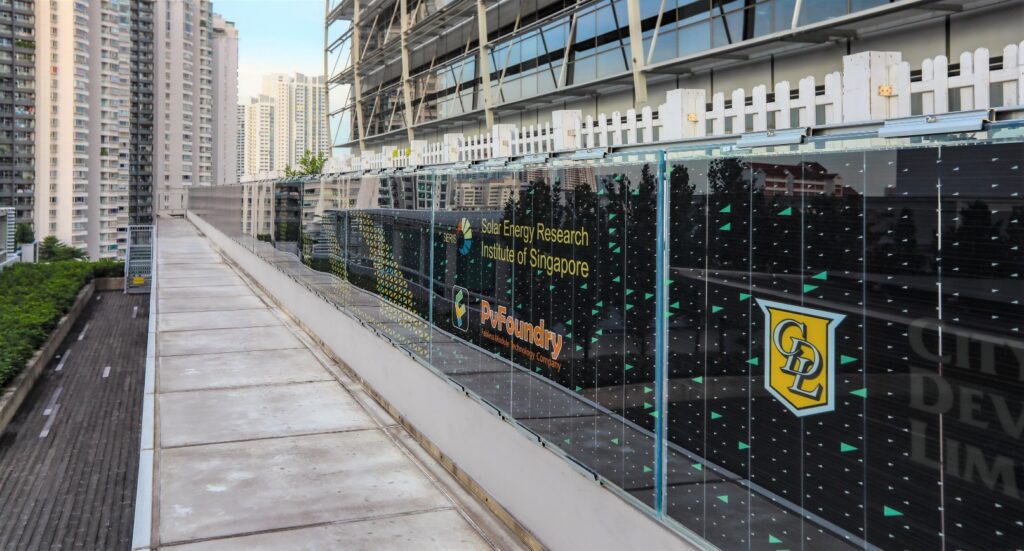
CDL also capitalises on the power of cross-sector partnerships to develop low-carbon technologies. The company has partnered with the Solar Energy Research Institute of Singapore to pilot Building-Integrated Photovoltaics (BIPV) modules and panels at various developments. The pilot on Bifacial BIPV panels with prints at CDL’s Sustainability Academy aims to optimise aesthetic value whilst generating power.
CDL and SERIS piloted a new generation of PV art wall (bifacial BIPV panels) at the Singapore Sustainability Academy at City Square Mall in 2020. This serves as a testbed for more efficient PV Installations
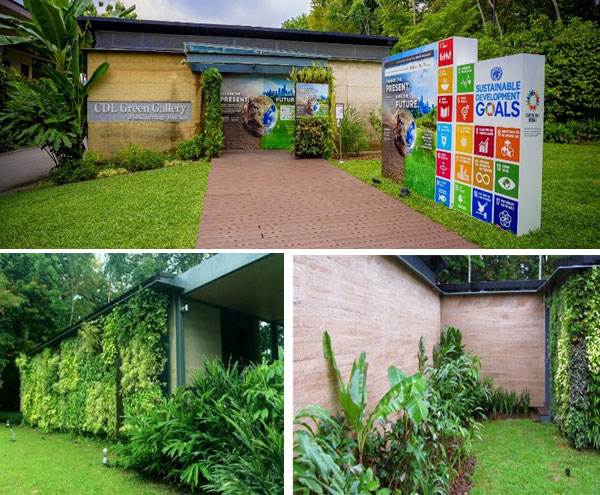
In order to achieve a net zero world, zero energy buildings are the way forward. To date, CDL has built two net zero facilities using eco-friendly technologies—the Singapore Sustainability Academy (SSA) and the CDL Green Gallery at the Singapore Botanic Gardens. The SSA, a BCA Green Mark Platinum-certified building, is the first in Singapore to have its construction materials, Cross Laminated Timber and Glued Laminated Timber, verified by the Nature’s BarcodeTM system as coming from responsible sources.
The SSA is the first ground-up initiative and zero-energy facility in Singapore dedicated to capacity building and thought leadership for climate action. Since its opening in 2017, it has tapped on 3,200 sq ft of solar panels on its rooftop as its energy source. The entire facility is built with over 80% of structural materials that come from sustainable sources.
In February 2021, CDL became the first real estate conglomerate in Southeast Asia to sign on to the World Green Building Council’s (WorldGBC) Net Zero Carbon Buildings Commitment. At COP26, CDL was one of 44 pioneering companies to expand its commitment towards a net-zero whole life carbon-built environment. Through this commitment, CDL pledged net zero operational carbon by 2030 for its new and existing wholly-owned assets and developments under its direct operational and management control. This also entails a reduction in embodied carbon and compensating residual upfront emissions via offsetting for new developments by 2030 and for all buildings to be net zero carbon by 2050.
To move towards a low carbon economy, CDL has aligned itself with even more ambitious carbon emissions reduction targets that have been successfully assessed and validated by Science Based Targets Initiative (SBTi) in 2021, in line with a 1.5°C warmer scenario. CDL was the first Singapore real estate company to validate its targets by SBTi for a 2°C warmer scenario in 2018.
The CDL Green Gallery is built with several eco-friendly technologies, including two innovative features – the biomaterial known as Hempcrete (largely made from the hemp plant) and a prefabricated modular system.
Investment: Building Leverage for the Future via Sustainable Finance
CDL’s Republic Plaza Green Bond was the first green bond issued by a Singapore company in April 2017.
CDL has secured more than $3 billion worth of sustainable finance, in the form of various green loans, a green bond, and a sustainability-linked loan, to help accelerate its green building action. It takes pride in issuing the first green bond by a Singapore company in 2017, which has helped to tap into alternative financing streams. In September 2021, CDL secured a discount for the SDG Innovation Loan provided by DBS Bank Ltd, for its successful R&D and pilot of digiHUB. This enabled CDL to be the first Singapore entity to achieve a discount on a sustainability-linked loan through the adoption of an innovative project that supports the SDGs on a large-scale basis.
At CDL’s mixed-use development South Beach, PV panels have been installed at the tower roof and louver modules, covering a total area of approximately 1,800 m2.
What gets measured gets managed—CDL’s longstanding experience in ESG disclosure and sustainability has helped it identify gaps and improve its ESG performance. Its robust ESG integration and disclosures are widely recognised by 13 global ratings, rankings and indexes, including double ‘A’s in the 2021 CDP Global A List for corporate climate action and water security.
CDL is honoured to have achieved its best performance in the Corporate Knights’ 2022 Global 100 Most Sustainable Corporations in the World, jumping from 40th place in 2021 to 5th position this year. In addition, it has maintained its ranking as the world’s top real estate management and development company and Singapore’s top sustainable company for the fourth consecutive year, and has been the first and only Singapore company to be included in the renowned index for 13 consecutive years.
The race to zero requires conviction and engagement with all stakeholders. After two decades of integrating ESG into our business, we have captured growth opportunities while mitigating ESG risks, enhancing value for our investors, communities, and the planet.
Across the Asia Pacific, what are companies doing to achieve NET ZERO carbon emissions?
APREA’s latest issue of Knowledge Brief, The Race to Net Zero, gathers thought leaders in the region, from real estate developers and investors to assets managers and technology providers, providing insightful perspectives and best practices on how businesses and stakeholders in the real assets sector can embark on a journey to #sustainability.
What will 2022 and the next decade bring? In recent years, climate change has come to surpass corporate governance as the most pressing ESG issue commanding investors’ attention, and ESG investing truly has gone mainstream (and is attracting the regulatory attention to prove it). Yet there are new risks emerging for companies, investors and the planet in the coming decade that will test how well we have learned the lessons of the past.
essensys Research: The Science of Flexible Real Estate Portfolio Management
Discover the Disconnect Between Landlords & Tenant Expectations Did you know that only 13% of tenants believe landlords are strongly positioned to serve their flexibility requirements?
The research addresses the following questions:
What are enterprises looking for in their commercial property?
How does flex space and tech feature in landlord and occupier real estate strategies?
What are the financial benefits on offer for landlords that effectively provide flex space?
The Growth Engines of Innovation: How Asia Pacific’s technology hubs are reshaping regional real estate (Colliers)
In this report, we examine:
The top 10 established and upcoming technology submarkets within major APAC cities, including key and upcoming key tech subsectors, and workplace and real estate considerations in each submarket
The rapid growth of Chinese tech firms as a major new class of owner-occupier
Opportunities and strategy recommendations for technology occupiers planning for expansion
Opportunities for property owners and investors beyond rental growth
Growth engines of innovation: Technology hubs reshaping real estate
The top five technology centres in APAC are Beijing, Shanghai, Bengaluru, Shenzhen and Singapore. Other cities are developing strengths in specific areas of technology, e.g., Seoul and Hong Kong in fintech, while in Hyderabad and Sydney are emerging
Among upcoming Indian submarkets, Colliers highlights Whitefield and North Bengaluru in Bengaluru, Peripheral Business District in Hyderabad, and Noida Expressway and Golf Course Extension Road (Gurguram) in Delhi NCR, among others.
In APAC, technology occupiers should account for 20%-25% of office leasing demand in the next five years. Our research identifies the most attractive technology submarkets across APAC to help occupiers plan their expansion
The emergence of technology groups as large owner-occupiers creates a new source of capital for investors planning asset disposals, as well as new opportunities for joint ventures and partnerships for developers.
Customer expectations, advancing technology and a burgeoning build-to-rent sector are encouraging the best residential landlords to boost their “digital kerb appeal”, says Yardi’s Paul Yount.
Yount, Yardi’s industry principal and product manager for RENTCafé, says renters no longer expect to spend their Saturdays pounding the pavement or filling in dozens of rental application forms.
“We know many apartment hunters prefer online interactions, and 14 per cent of today’s apartment renters are willing to sign a lease without even seeing the property in person,” he says.
The explosion of ecommerce in recent years has driven an evolution in customer expectations. If a customer can expect a fast and frictionless experience when they make a purchase online, why wouldn’t they expect the same experience when choosing their next apartment?
“Physical kerb appeal has always been important in real estate. But now digital kerb appeal is more important,” Yount explains.
Virtual tours, a phenomenon already gathering speed before COVID-19, are now the preferred way for renters to select their next apartment, Yount adds. He points to a Yardi survey of RENTCafé users which found nearly a third (31%) preferred self-guided tours or had no preference, pre-COVID.
“Now, most renters would prefer a self-scheduled tour in their next apartment search – in fact 83 per cent of apartment shoppers tell us they’d prefer to take a self-guided tour if one was available.”
Yardi’s research is backed up by the largest survey of apartment residents, undertaken by the National Multifamily Housing Council in the United States. This survey, which got inside the minds of 372,000 apartment residents in 2020, found:
100% would prefer to engage with a mobile app rather than a website
90% want to make an individual apartment selection online and
81% want videos of apartment models and amenities.
The appeal of self-guided tours, powered by Yardi’s technology, is not just about social distancing. Two thirds of renters want to tour a property at their own pace, and just under half want to check out a property after hours.
Does that mean today’s renter prefers a high-tech experience over a high-touch, personalised approach? Yount compares the expectations of today’s renter with that of a grocery shopper.
“Some people like old-school checkouts, others prefer self-checkout, some like kerbside pickups while others opt for delivery services. Today’s consumer wants to do business in a lot of different ways.”
So, what are Yardi’s top three high-tech, high-touch plays to build loyalty and create long-term connections with renters?