
ESG

Rajah & Tann’s Sustainability Practice brings to you the inaugural issue of the Sustainability Updates which shares with you insights distilled from conversations between our Sustainability Partners and experts across sectors and domains on key environmental, social and governance (“ESG”) developments and trends. In this issue, Lee Weilin and Soh Lip San, our Partners with the Sustainability Practice, explore ESG issues in infrastructure projects by speaking with Seth Tan, Executive Director of Infrastructure Asia (“InfraAsia”), on his views on green and sustainable infrastructure and ESG factors for bankable projects in the region.


Rajah & Tann’s Sustainability Practice brings to you the inaugural issue of the Sustainability Updates which shares with you insights distilled from conversations between our Sustainability Partners and experts across sectors and domains on key environmental, social and governance (“ESG”) developments and trends. In this issue, Lee Weilin and Soh Lip San, our Partners with the Sustainability Practice, explore ESG issues in infrastructure projects by speaking with Seth Tan, Executive Director of Infrastructure Asia (“InfraAsia”), on his views on green and sustainable infrastructure and ESG factors for bankable projects in the region.

To read the article in PDF, please click below

APREA advocates the adoption of ESG and Sustainability Best Practices in the real assets industry. Making sustainable investment decisions is increasingly a part of APREA members’ DNA, and APREA is committed to be at the forefront of that transition to a net-zero world.


APREA advocates the adoption of ESG and Sustainability Best Practices in the real assets industry. Making sustainable investment decisions is increasingly a part of APREA members’ DNA, and APREA is committed to be at the forefront of that transition to a net-zero world.

Recently, APREA together with its ESG and Sustainability Committee conducted an ESG Member Survey to find out real assets companies’ sentiments towards their implementation of ESG.


Now more than ever sustainability and ESG topics are coming to the forefront across the globe from a diverse group of stakeholders including employees, customers, suppliers, communities, investors and regulators. Driven in part by the Covid-19 pandemic, there is a focus on employee health & safety, supply chain resilience, and corporate culture, along with growing concerns on climate risk to reputation and the associated impact on corporate value creation.


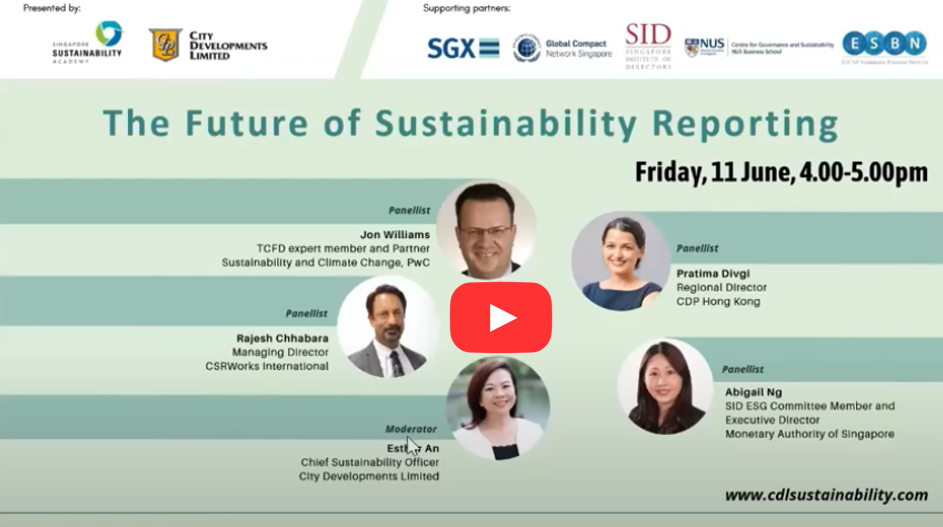
Following the ESG webinar jointly presented by DFIN (Donnelley Financial Solutions), SGX RegCo and industry leaders in October 2020, DFIN’s John Truzzolino, Director of Corporate Governance Services continued the dialogue with Esther An, Chief Sustainability Officer of City Developments Limited (CDL). Esther is an active advocate for green building and sustainability, she spearheaded the publication of the first sustainability report using GRI standards in Singapore in 2008. Today, CDL is ranked as a top real estate company on the Global 100 Most Sustainable Corporations in the World 2020 list.

Watch the full interview to learn more about CDL’s sustainability journey, and hear Esther’s suggestions to businesses on driving preparedness for climate change, improving investor communications and creating decision-useful disclosures in the post-pandemic era.

Watch the Interview Here

Many institutional investors are facing their greatest challenges for many years. They are transforming their investment processes at high speed to reflect today’s imperatives, such as environmental, social and governance (ESG) investing, innovative technology, ever-shifting regulations and demands for greater transparency. Yet they must do this in a complex and unstable financial environment. I compare this challenge to changing the sails and masts of a ship as it is battered by a storm. For this report, we surveyed 200 asset owners (pension funds, insurers, sovereign wealth funds and endowments/foundations) owning assets of around $18 trillion. Reading it, I was struck by how the pandemic has further accelerated the shift to ESG. Asked for the top 3 trends that will affect their organization over the next three to five years, 62% cited either climate change or the increasing complexity of ESG measurement — far ahead of other themes such as market volatility and regulation. But it is not the only transformation. A new wave of data technologies is bringing very significant changes to investment processes. These technologies open the door to new ways of understanding markets and increasing efficiency.

The physical impacts of climate change on the built environment are becoming more significant and have the potential to be extremely costly. With their locations fixed, buildings themselves may be at risk of suffering significant damage costs from climate change impacts. More so, buildings are often energy-intensive to build and operate. They are responsible for over a third of global final energy consumption and CO2 emissions, with operational emissions mostly through space heating and cooling, and water heating (IEA, 2019). MSCI’s scenario analysis for commercial and residential real estate enables investors and real estate managers to evaluate both transition and physical climate-related impacts in their portfolios.

Find out more about MSCI Real Estate Climate Value-at-Risk solution here

Green Real Estate Trend #1 GREEN IS IN

Green Real Estate Trend #2 CERTIFICATION VS. GREENWASHING

Green Real Estate Trend #3 USERS ARE DRIVING GREEN

Green Real Estate Trend #4 GREEN BUSINESS IS GOOD BUSINESS

More and more investors are integrating ESG risks into their investment process. Given the large size and specialized nature of real estate assets, the investment community has demanded sophisticated tools to more accurately identify real estate companies that own more sustainable properties and integrate this information seamlessly into their investment process.

S&P Dow Jones Indices has collaborated with GRESB, a leader in evaluating ESG characteristics of real estate companies, to create the Dow Jones Green Real Estate Indices. The indices, which utilize data from GRESB, are designed to be representative of the investment characteristics of conventional real estate benchmarks, but with an improved sustainability profile.

For over two decades, CDL has been managing our business with the triple bottom line in mind – People, Planet and Profits, which are intricately linked for our long-term viability and growth. Besides upholding CDL’s track record in ESG integration, we continually innovate, invest and improve our six capitals to be future-ready. Today, the urgency for …


For over two decades, CDL has been managing our business with the triple bottom line in mind – People, Planet and Profits, which are intricately linked for our long-term viability and growth. Besides upholding CDL’s track record in ESG integration, we continually innovate, invest and improve our six capitals to be future-ready.

Today, the urgency for decisive leadership, strong collaboration and financing to enable climate action is clear. At CDL, we are strongly committed to be a catalyst of change to achieve the UN Global Goals for sustainability. 2019 will be a year that sees further acceleration of our goals and initiatives for a sustainable future, as we pursue CDL’s vision of Building Value for Tomorrow, Today.

This Report contains a full year’s data from 1 January to 31 December 2018 and focuses primarily on operations owned and managed by CDL’s Singapore headquarters, excluding that of our subsidiaries. The scope covers our principal business as a real estate management and development company, comprising operational functions such as asset management of commercial and industrial developments, our corporate headquarters in Singapore as well as project development. In 2018, property development was the main contributor to CDL’s pre-tax profit.